Full Moon Names, Meanings, and Special Moons
The full moon is one of the most powerful and evocative moments in the lunar cycle. It has been celebrated, named, and ritualized by cultures around the world for centuries. But did you know that there are multiple naming traditions for each full moon? Or that some moons carry special significance as “supermoons,” “blue moons,” or even “blood moons”?
This page covers the 12 monthly full moon names, the different systems behind them, and special events such as Blue Moons, Supermoons, and Blood Moons. Use the names as seasonal references, not as one universal calendar.

Why Are Full Moons Named?
For centuries, people have given names to the full moons to mark time, track the seasons, and honor the cycles of nature.
- Practical: Farmers and hunters used these names to track planting, harvesting, and hunting seasons.
- Spiritual: Full moons were (and are) used for rituals, festivals, and storytelling.
- Cultural: Different traditions (Indigenous, European, modern Pagan, etc.) developed their own sets of names.
Today, we often use a blend of naming traditions, with many drawn from the Old Farmer’s Almanac (itself influenced by Algonquin and European sources) and modern Pagan adaptations (like those found in Llewellyn’s Witch’s Calendar).
Important note: Naming traditions vary by culture, region, and calendar. There’s no single “correct” set of names — and that’s part of their beauty.
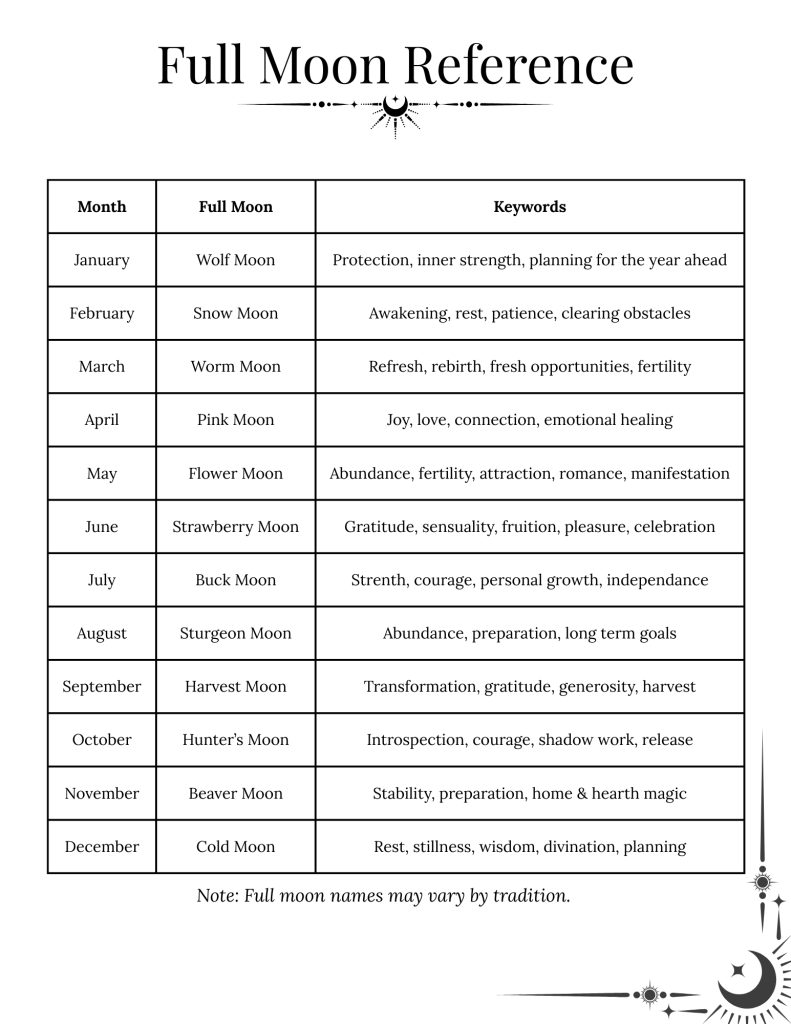
The 12 Monthly Full Moons (and Their Meanings)
Here are the most common names for each full moon, along with their themes.
January: Wolf Moon
- Themes: Survival, strength, inner wisdom.
- Origins: Named for the howling wolves of midwinter.
- Great for: Protection magic, building resilience, setting boundaries.
February: Snow Moon
- Themes: Reflection, rest, purification.
- Origins: Reflecting the heavy snows in the Northern Hemisphere.
- Great for: Cleansing rituals, shadow work, emotional healing.
March: Worm Moon
- Themes: Growth, fertility, awakening.
- Origins: Signaling the return of earthworms and thawing soil.
- Great for: Planting new intentions, grounding, connecting with Earth energy.
April: Pink Moon
- Themes: Joy, renewal, love.
- Origins: Likely named for the phlox flowers that bloom in early spring.
- Great for: Love magic, creative renewal, celebration of beauty.
May: Flower Moon
- Themes: Abundance, fertility, creativity.
- Origins: Reflecting the explosion of blooming flowers.
- Great for: Prosperity spells, growth rituals, honoring fertility cycles.
June: Strawberry Moon
- Themes: Fruition, pleasure, gratitude.
- Origins: Marks the strawberry harvest season.
- Great for: Gratitude practices, celebrating your progress, joy-filled rituals.
July: Buck Moon
- Themes: Personal power, courage, self-development.
- Origins: Named for the new antlers of bucks emerging in midsummer.
- Great for: Strength-building spells, confidence work, affirmations.
August: Sturgeon Moon
- Themes: Gratitude, sustenance, resourcefulness.
- Origins: From the sturgeon fish caught in abundance in August.
- Great for: Community rituals, resource-sharing, preparing for harvest season.
September: Harvest Moon
- Themes: Completion, gratitude, celebration.
- Origins: Closest full moon to the autumn equinox.
- Great for: Thanksgiving rituals, offering gratitude, celebrating achievements.
October: Hunter’s Moon
- Themes: Preparation, letting go, shadow work.
- Origins: Traditionally the time for hunting game and preserving food for winter.
- Great for: Protection magic, shadow work, releasing old patterns.
November: Beaver Moon
- Themes: Rest, protection, resource-gathering.
- Origins: The season when beavers build their winter dams.
- Great for: Home blessings, preparation rituals, protection charms.
December: Cold Moon
- Themes: Peace, stillness, introspection.
- Origins: Reflecting the deep cold and darkness of winter.
- Great for: Meditation, divination, ancestral connection.
Variations Across Naming Traditions
Not every source agrees on these names.
Llewellyn’s Witch’s Calendar
Often uses similar names but sometimes shifts them to better align with Pagan seasonal themes. For example, August is often called the Corn Moon in Llewellyn’s system (to reflect Lammas/Lughnasadh themes), while the Farmer’s Almanac places “Corn Moon” in September.
Indigenous & Regional Names
Algonquin, Dakota, Cree, and other Indigenous peoples have their own full moon naming systems, often tied to the local ecology and seasonal cycles. These may differ significantly from the more commonly published lists.
Modern Witchcraft Traditions
Many witches adopt or blend naming systems to align with their personal practice or geographical location. For example:
- A Southern Hemisphere practitioner may flip the associations to match opposite seasonal cycles.
- Some practitioners choose intuitive names based on their own observations of nature each month.
Note: There’s no universal “right” name for any given moon — use the system (or create your own) that feels most meaningful for your practice.
Special Full Moons
In addition to the 12 monthly moons, some full moons get special names based on astronomical events:
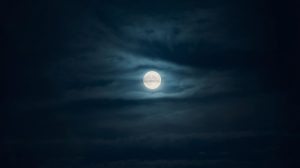
Blue Moon
- A second full moon in a single calendar month or a rare “extra” full moon in a season.
- Themes: Once-in-a-lifetime goals, transformation, magic that breaks the rules.
Supermoon
- A full moon that appears larger because it’s at its closest point to Earth.
- Themes: Amplification, high energy, bold intentions.
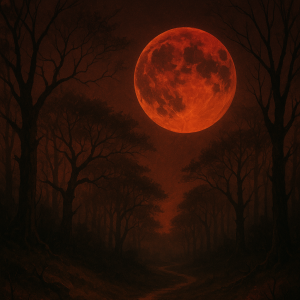
Blood Moon
- A total lunar eclipse when the moon appears reddish.
- Themes: Deep shadow work, transformation, endings, and rebirth.
These moons can be energetically intense — ideal for powerful rituals, shadow work, or once-in-a-lifetime spellwork. Not every lunar eclipse is a Blood Moon, though: if only part of the Moon enters Earth’s dark shadow, it is a partial lunar eclipse. For more on Blood Moon energy, check out our Blood Moon Water post.
The Full Moon Energy Window (More Than One Night)
Astronomically, the full moon is a single moment when the moon is opposite the sun. Energetically, though, most people experience it as more of a slow rise and fall.
For practical ritual work, the full moon lasts about three days:
• The day before:
The full moon energy is already building. Many people feel intuitive or emotionally heightened.
• The official full moon date:
This is the brightest and most intense point of the cycle.
• The day after:
The energy is still strong, but beginning to unwind. This is a supportive time for reflection, grounding, and release.
You do not need to perform your ritual at the exact minute the moon peaks. The full moon’s influence is wide, forgiving, and available when you are. Really you don’t have to perform any extensive ritual. I often do a simple smoke cleanse of my home on the night of the full moon, and that’s it.
How to Use This Knowledge in Practice
Knowing the names and meanings of each moon lets you work with the lunar cycle in a deeper, more intentional way.
- Create monthly moon water: Align the energy of your moon water with the specific monthly theme (see: When to Make Moon Water).
- Plan rituals: Incorporate these themes into your Full Moon Rituals.
- Build a moon journal: Track how each full moon feels for you over time.
- Honor the season: Connect your rituals to Sabbats and seasonal changes for added potency.
FAQs About Full Moon Names
Do I have to use the traditional names?
No. These names are guides. You can create your own based on your environment or personal symbolism.
Are these names the same in the Southern Hemisphere?
Not necessarily. Many witches in the Southern Hemisphere adjust names to match their seasonal cycles.
Can I use more than one naming system?
Absolutely. Many modern practitioners blend Indigenous, European, and intuitive systems.
Do these names have magical power?
The names themselves aren’t inherently magical, but the intent and meaning you bring to them are what matter in your practice.
Full moons are more than bright lights in the night sky — they’re markers of time, season, and spiritual rhythm. Whether you use the Wolf Moon to build inner strength in winter or the Harvest Moon to celebrate abundance in autumn, each full moon offers a chance to align with the cycles of nature.
And as you explore these traditions, remember: the names are flexible. Make them your own.