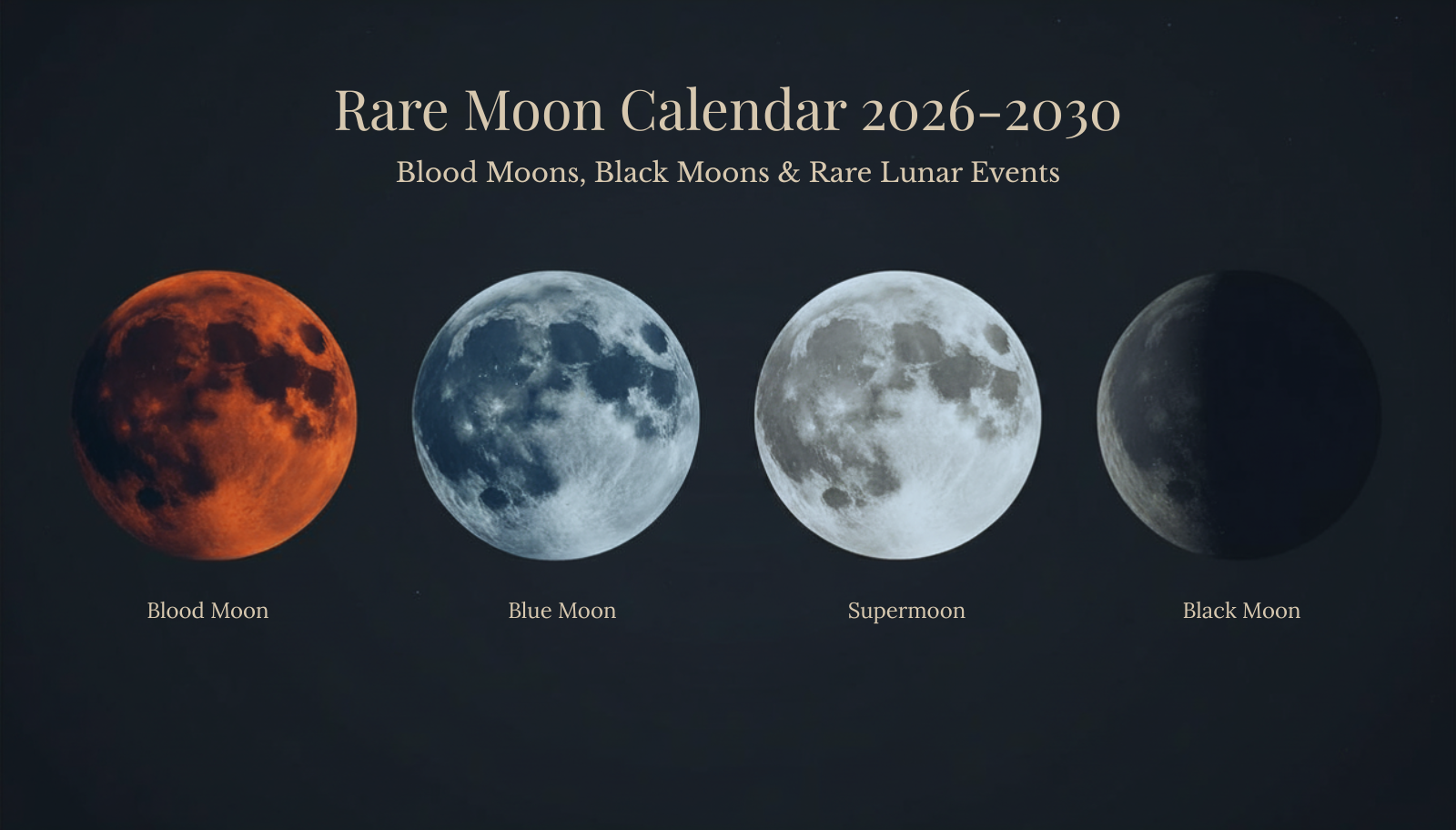
Rare Moons Explained: Blood Moons, Blue Moons & More
Understanding Rare Moons
Rare moons tend to attract attention fast. A red eclipse moon suddenly shows up in everyone’s photos. Someone mentions a Blue Moon online. A giant Full Moon starts rising over the horizon and people start wondering whether it actually looks bigger or if the internet is exaggerating again.
The problem is that lunar terminology gets confusing quickly. Some rare moon events are based on astronomy, while others come from seasonal systems, folklore, or naming conventions that changed over time. Depending on the source, the same moon event might even be defined differently.
This page separates the astronomy from the naming systems used for Blood Moons, Blue Moons, Black Moons, and Supermoons, with older seasonal definitions included where they matter.
Use it as a reference for ritual planning, folklore, moon water, gardening, photography, journaling, or plain curiosity. You do not need a spiritual practice to understand what is happening in the sky.
Table of Contents
What Moon Events Are Happening in 2026?
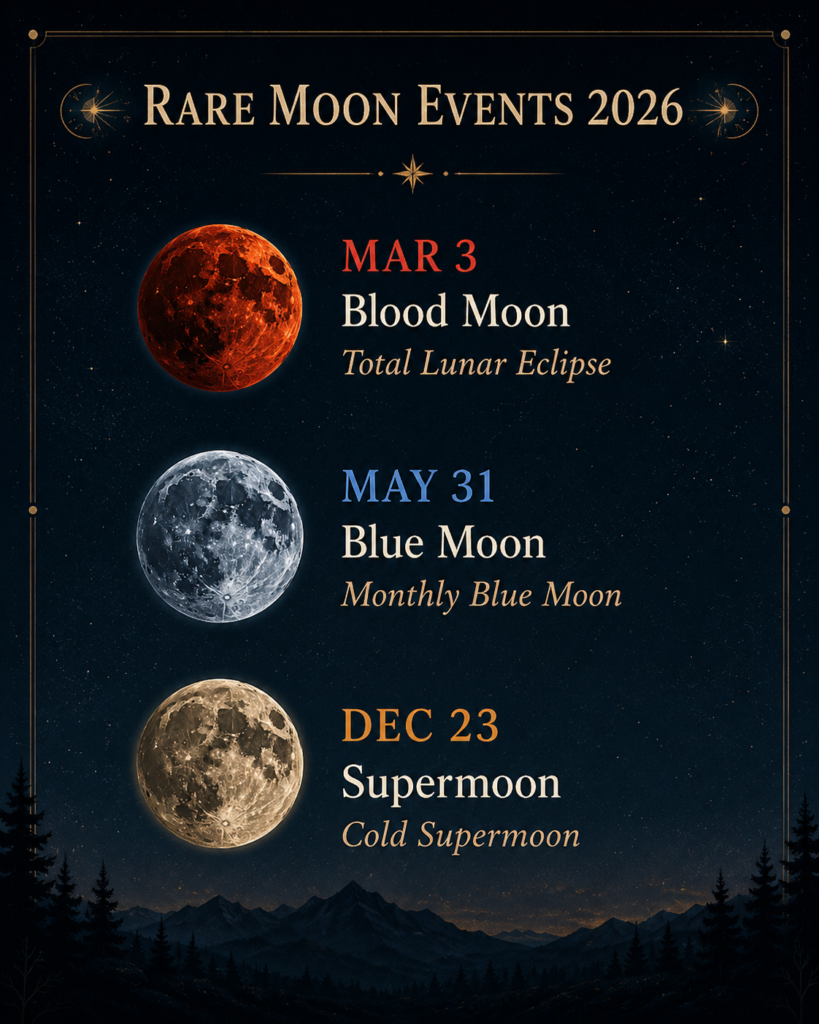
2026 includes several notable lunar events, including:
- a total lunar eclipse Blood Moon in March
- a Monthly Blue Moon in May
- a Blue Moon Micromoon overlap event
- and multiple Supermoons later in the year
For people just starting to track lunar events, 2026 is actually a pretty active year.
What Is a Rare Moon?
“Rare Moon” is not an official astronomy category. It is more of an umbrella term used to describe lunar events that happen less frequently than a standard monthly moon cycle.
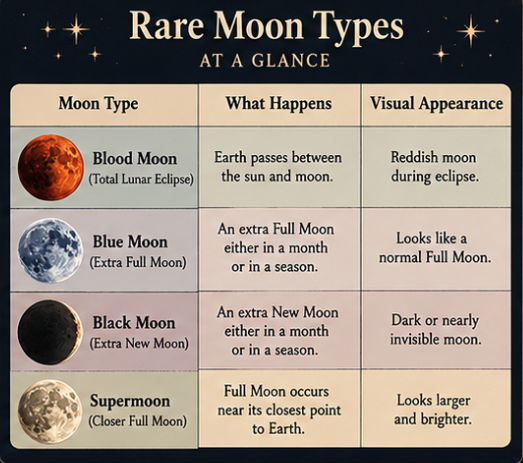
Rare moons are based on:
- eclipses
- orbital distance
- multiple Full or New Moons in a month
- seasonal moon cycles
Not every rare moon is equally rare. Some Supermoons happen several times a year, while certain Black Moon alignments only occur every few years.
Blood Moon
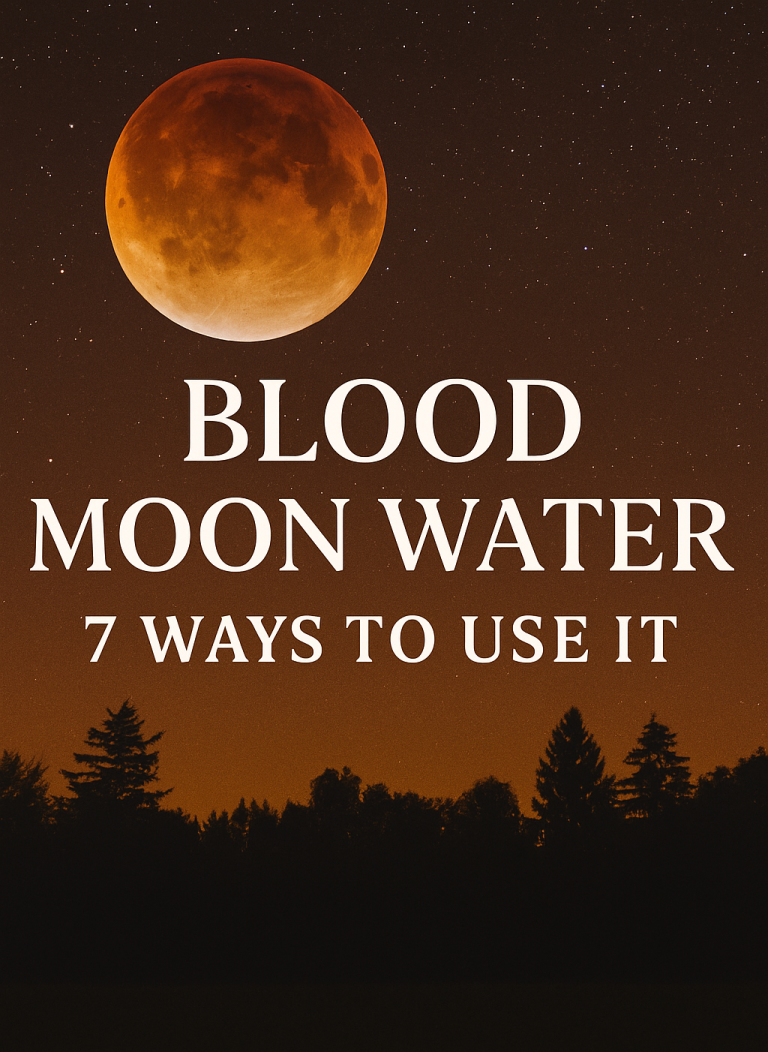
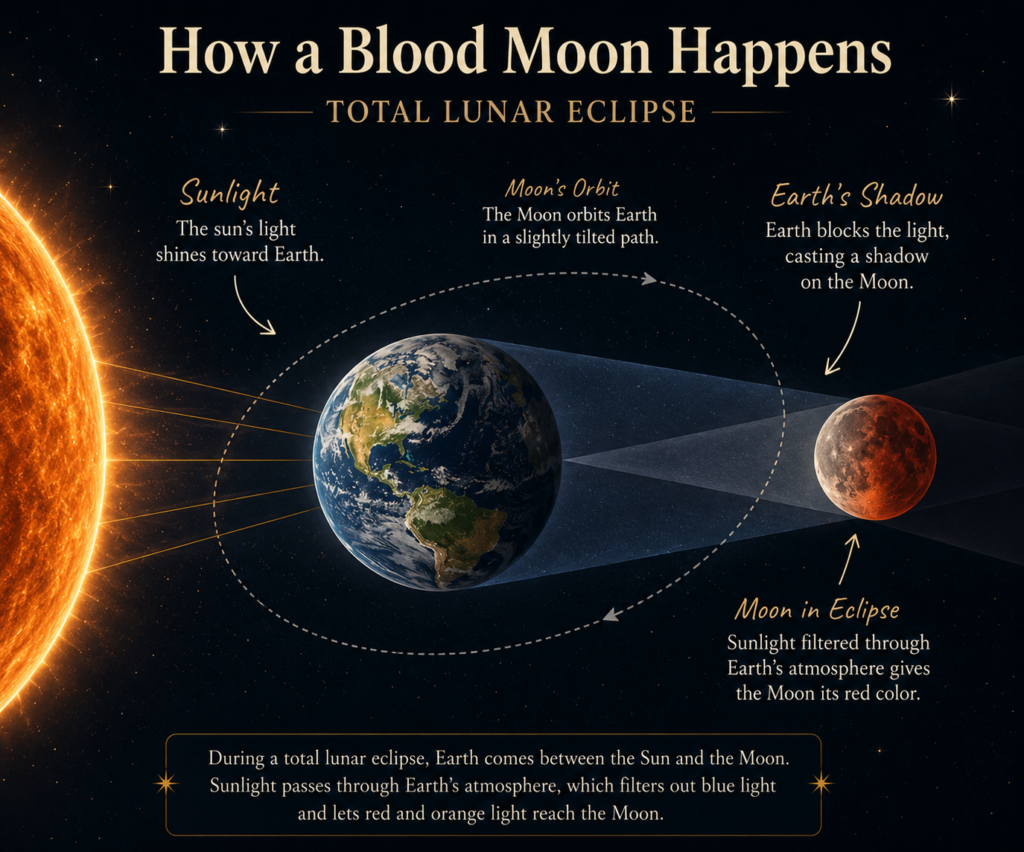
A Blood Moon happens during a total lunar eclipse when the Earth passes between the sun and the moon, casting a reddish shadow across the moon’s surface.
The moon is not literally turning blood red on its own. The color comes from filtered sunlight passing through Earth’s atmosphere during the eclipse.
Not every lunar eclipse is total. If only part of the Moon enters Earth’s dark umbral shadow, it is a partial lunar eclipse instead; our partial lunar eclipse guide covers the astronomy, symbolism, rituals, and eclipse moon water.
When Is the Next Blood Moon?
The next total lunar eclipse Blood Moon occurs on December 31, 2028.
Additional notable Blood Moons include:
- June 26, 2029
- December 20, 2029
Lunar eclipses inspired folklore long before people understood the astronomy behind them. In many traditions, eclipses were explained as the moon being swallowed, attacked, or “eaten” by supernatural creatures, which is part of why Blood Moons developed such ominous reputations historically. Stories about dragons, wolves, serpents, or other celestial beings consuming the moon appear across multiple cultures and eclipse traditions. In some Southeast Asian eclipse traditions, people once believed a dragon or serpent was attempting to consume the moon during an eclipse and created loud noises to drive it away.
Because of those long-standing associations, Blood Moons are still commonly tied to disruption, endings, revelation, or periods of instability in modern spiritual practices.
In modern practice, some people use Blood Moons for:
- shadow work
- banishment
- protection rituals
- uncrossing
- divination
- severing unhealthy ties
Others avoid eclipse work entirely because eclipse energy is considered unstable or disruptive.
Practices surrounding eclipse moons vary widely between traditions and individual practitioners.
See also: Blood Moon Rituals & Meanings
Blood Moon Water: How to Collect It & 7 Powerful Ritual Uses
Blue Moon
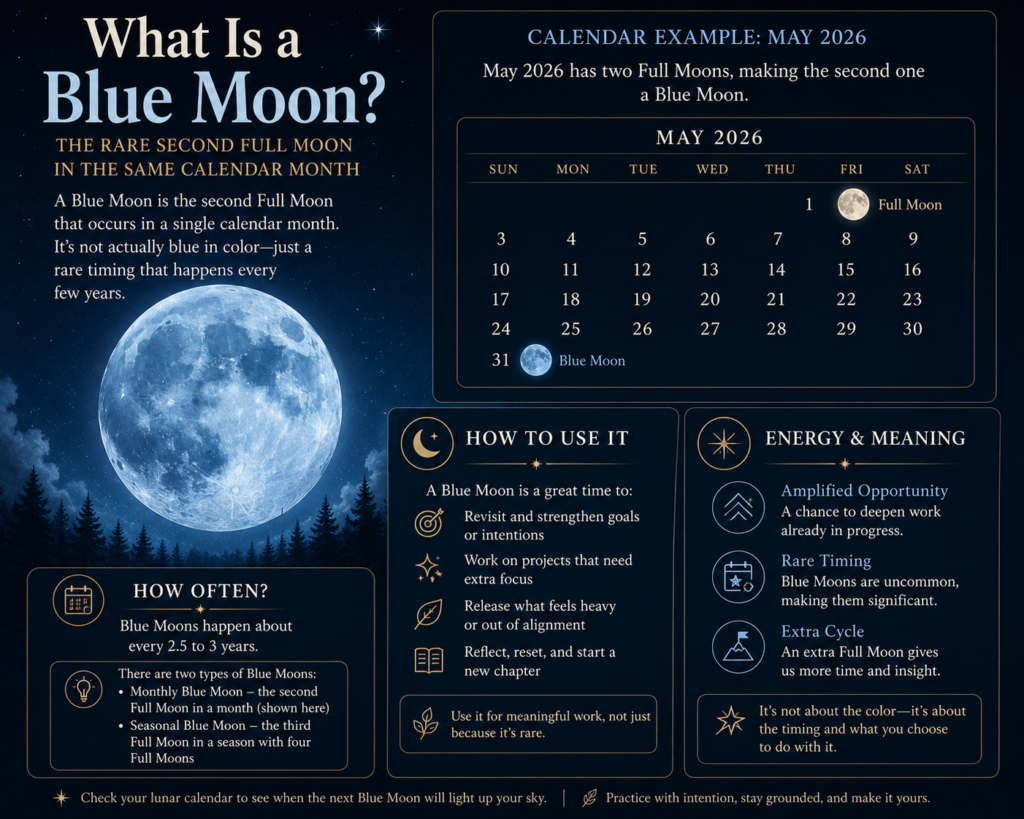
A Blue Moon can refer to two different lunar events depending on the system being used. Most people today use the monthly definition, where a Blue Moon is the second Full Moon in a single calendar month. However, the older traditional definition describes a Blue Moon as the third Full Moon in a season containing four Full Moons.
Interestingly, the seasonal definition came first. The now more familiar monthly version became widespread later after a publishing mistake eventually entered mainstream use and stuck.
When Is the Next Blue Moon?
The next Blue Moon occurs on May 31, 2026.
Additional notable Blue Moons include:
- May 20, 2027
- December 31, 2028
- August 23, 2029
Part of the Blue Moon’s mystique comes from the phrase “once in a blue moon,” which turned an uncommon lunar event into shorthand for anything rare, strange, or unlikely. That cultural association still shapes how many people think about Blue Moons today.
Because Blue Moons involve an “extra” Full Moon within an existing cycle, they are often associated with revisiting unfinished goals, extending ongoing work, or returning to things that were previously delayed or abandoned.
Compared to Blood Moons or Black Moons, Blue Moon symbolism tends to feel less heavy and more transitional — more about unusual timing, repetition, or unexpected opportunities than endings or upheaval.
See also: Blue Moon Rituals & Meanings
Black Moon
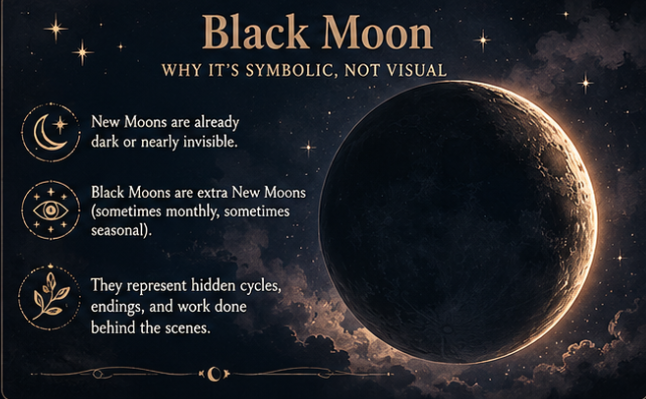
Black Moon terminology gets confusing fairly quickly because several definitions are used today.
A Black Moon most commonly refers to:
- the second New Moon in a calendar month
- or the third New Moon in a season containing four New Moons
Unlike Blood Moons or Supermoons, Black Moons are easy to miss completely unless you intentionally track moon cycles. Since New Moons are already dark and difficult to see, most Black Moon significance comes from timing and symbolism rather than appearance.
When Is the Next Black Moon?
The next widely recognized Black Moon occurs on August 31, 2027.
Additional notable Black Moons include:
- August 20, 2028
- June 30, 2030
Older folk practices often treated darker lunar periods differently than bright Full Moons. Rather than celebration or attraction work, darker phases were more commonly tied to concealment, protection, endings, or quiet removal work.
Compared to Full Moon rituals, Black Moon practices are often more focused on removal, protection, reflection, or closing cycles rather than attraction or celebration.
In modern practice, Black Moon symbolism is often tied to:
- endings
- hidden work
- banishment
- boundary-setting
- protection
- silence
- deep reflection
- cord cutting
- justice work
See also: Black Moon Meaning & Rituals
Supermoons
A Supermoon happens when a Full Moon occurs near the moon’s closest orbital point to Earth, making it appear somewhat larger and brighter in the sky.
The visual difference is real, though usually less dramatic than heavily edited internet photos make it seem.
Unlike eclipses, there is no single official scientific definition for a Supermoon, which means yearly lists may vary slightly depending on the source being used.
When Is the Next Supermoon?
The next notable Supermoon occurs on December 23, 2026.
Additional notable Supermoons include:
- January 22, 2027
- February 10, 2028
- March 10, 2028
Large low-horizon moons have inspired folklore and superstition for generations simply because people notice them more easily than ordinary Full Moons. Bright moons were sometimes connected to restless sleep, unusual behavior, heightened emotions, or strange events, even if modern science does not strongly support most of those beliefs.
Supermoons tend to create a similar reaction today. Even people who never follow moon phases often stop to notice when the moon appears unusually large or bright near the horizon.
In modern spiritual communities, Supermoons are often associated with:
- stronger focus on ongoing goals or intentions
- heightened visibility
- amplified Full Moon symbolism
- emotionally intense periods
See also: Supermoon Moon Magic & Meaning
Notable Lunar Event Overlaps
Some years include unusual combinations where multiple lunar events happen at the same time.
May 31, 2026
- Monthly Blue Moon
- Micromoon
December 31, 2028
- Blood Moon
- Monthly Blue Moon
These overlap events are part of why certain lunar dates attract significantly more attention than others.
Frequently Asked Questions
What is the rarest moon?
That depends entirely on which definition is being used. Certain Black Moon alignments are less common than Supermoons, while total lunar eclipses follow more predictable astronomical cycles.
Why do Blue Moon dates differ between sources?
Some calendars use the original seasonal Blue Moon definition while others use the newer monthly system.
Are Supermoons actually rare?
Not especially. Most years include several Supermoons depending on the classification system being used.
What is the difference between a Blue Moon and a Black Moon?
Blue Moons involve extra Full Moons. Black Moons involve extra New Moons.
Can you make moon water during an eclipse?
Yes. Whether you personally want to is more of a spiritual preference question than a rule.
Why does the moon turn red during a Blood Moon?
Earth’s atmosphere filters sunlight during a total lunar eclipse, creating the reddish appearance.
Not Every Moon Needs to Be a Major Event
You do not need to observe every rare moon or turn every lunar event into an elaborate ritual.
Realistically, most people pay attention to a few major lunar events each year and ignore the rest. That is normal.
The useful part of a rare moon calendar is simply knowing what is happening, when it is happening, and deciding whether any of it matters to your own routines, interests, or practice at all.